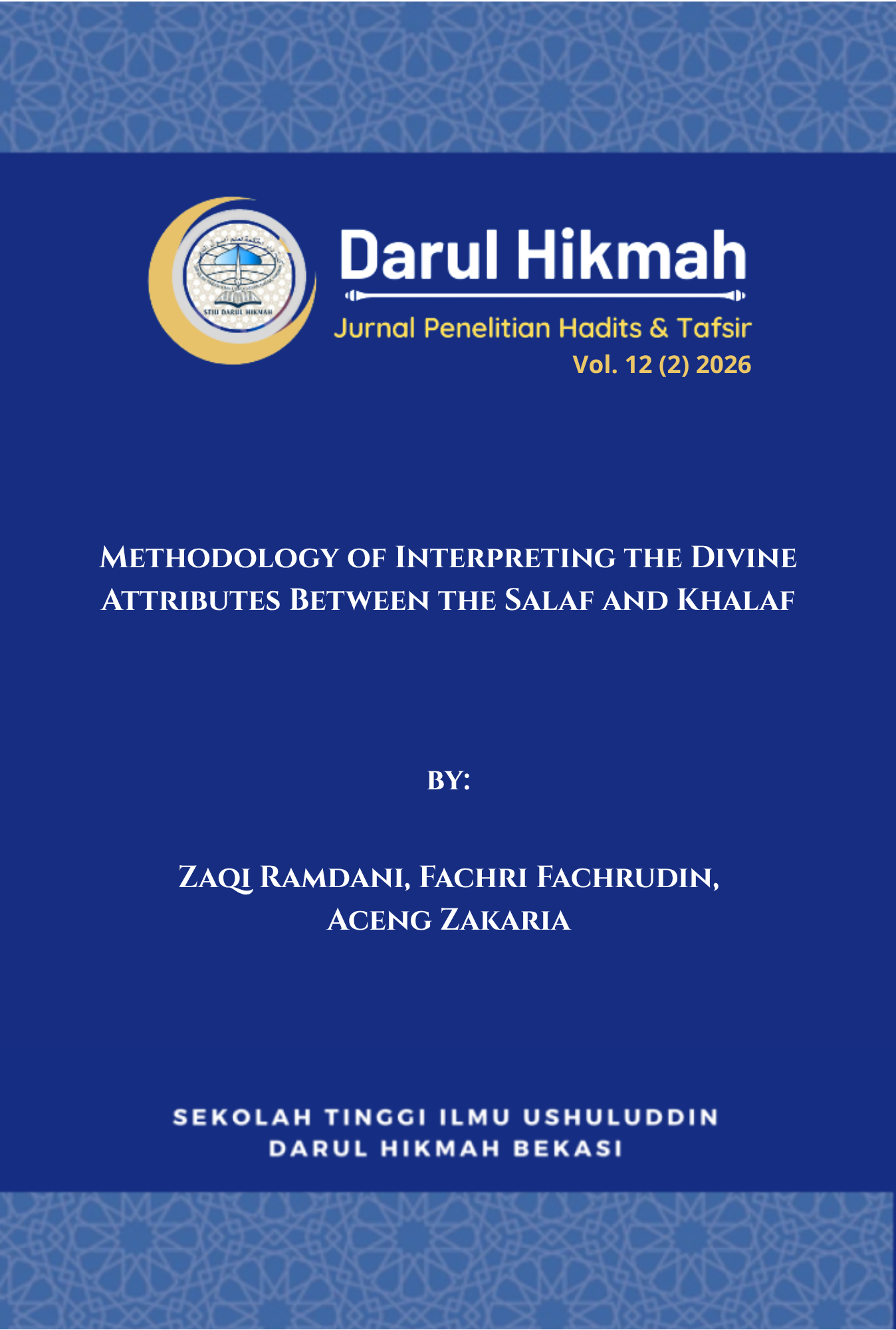
Methodology of Interpreting the Divine Attributes Between the Salaf and Khalaf
DOI:
https://doi.org/10.61086/jstiudh.v12i2.104Kata Kunci:
Khalaf, tafsir, Salaf, Tanzih, dzatiyahAbstrak
Perdebatan mengenai ayat-ayat sifat dzatiyah Allah dalam pemikiran Islam sering memicu polemik sektarian akibat pembacaan lahiriah terhadap wahyu. Penelitian ini mengkaji metodologi tafsir dalam penafsiran sifat dzatiyah Allah antara Salaf dan Khalaf dengan menempatkan keduanya sebagai orientasi metodologis, bukan sekadar periodisasi sejarah. Menggunakan pendekatan kualitatif berbasis studi kepustakaan dengan analisis komparatif (muqaran) terhadap karya tafsir dan teologi klasik, pembahasan difokuskan pada tiga lafaz Al-Qur'an: istiwa, yad, dan wajh. Hasil penelitian menunjukkan bahwa metodologi Salaf menegaskan lafaz wahyu (itsbat), menolak takyif, tasybih, tamtsil, dan ta'thil, serta menyerahkan kaifiyah kepada Allah. Sebaliknya, metodologi Khalaf menggunakan ta'wil kebahasaan berdasarkan analisis kontekstual ketika makna zahir berpotensi menimbulkan kesan jasmani (tajsim). Kontribusi utama penelitian ini terletak pada pemetaan logika metodologis internal kedua tradisi dalam menyeimbangkan komitmen kepada firman Allah dan prinsip penyucian Tuhan (tanzih). Penelitian ini menyimpulkan bahwa kedua pendekatan tersebut bertemu pada tujuan teologis yang sama, yaitu menjaga tanzih melalui mekanisme penafsiran yang berbeda, sehingga memberikan pijakan rasional bagi hermeneutika Al-Qur'an kontemporer.
Unduhan
Diterbitkan
Terbitan
Bagian
Lisensi
Hak Cipta (c) 2026 Darul Hikmah: Jurnal Penelitian Tafsir dan Hadits

Artikel ini berlisensiCreative Commons Attribution-NonCommercial-ShareAlike 4.0 International License.
This work is licensed under a Creative Commons Attribution-NonCommercial-ShareAlike 4.0 International License.
You are free to:
- Share — copy and redistribute the material in any medium or format
- Adapt — remix, transform, and build upon the material
- The licensor cannot revoke these freedoms as long as you follow the license terms.
Under the following terms:
- Attribution — You must give appropriate credit, provide a link to the license, and indicate if changes were made. You may do so in any reasonable manner, but not in any way that suggests the licensor endorses you or your use.
- NonCommercial — You may not use the material for commercial purposes.
- ShareAlike — If you remix, transform, or build upon the material, you must distribute your contributions under the same license as the original.
- No additional restrictions — You may not apply legal terms or technological measures that legally restrict others from doing anything the license permits.
Notices:
You do not have to comply with the license for elements of the material in the public domain or where your use is permitted by an applicable exception or limitation.
No warranties are given. The license may not give you all of the permissions necessary for your intended use. For example, other rights such as publicity, privacy, or moral rights may limit how you use the material.