ACCREDITATION BY:

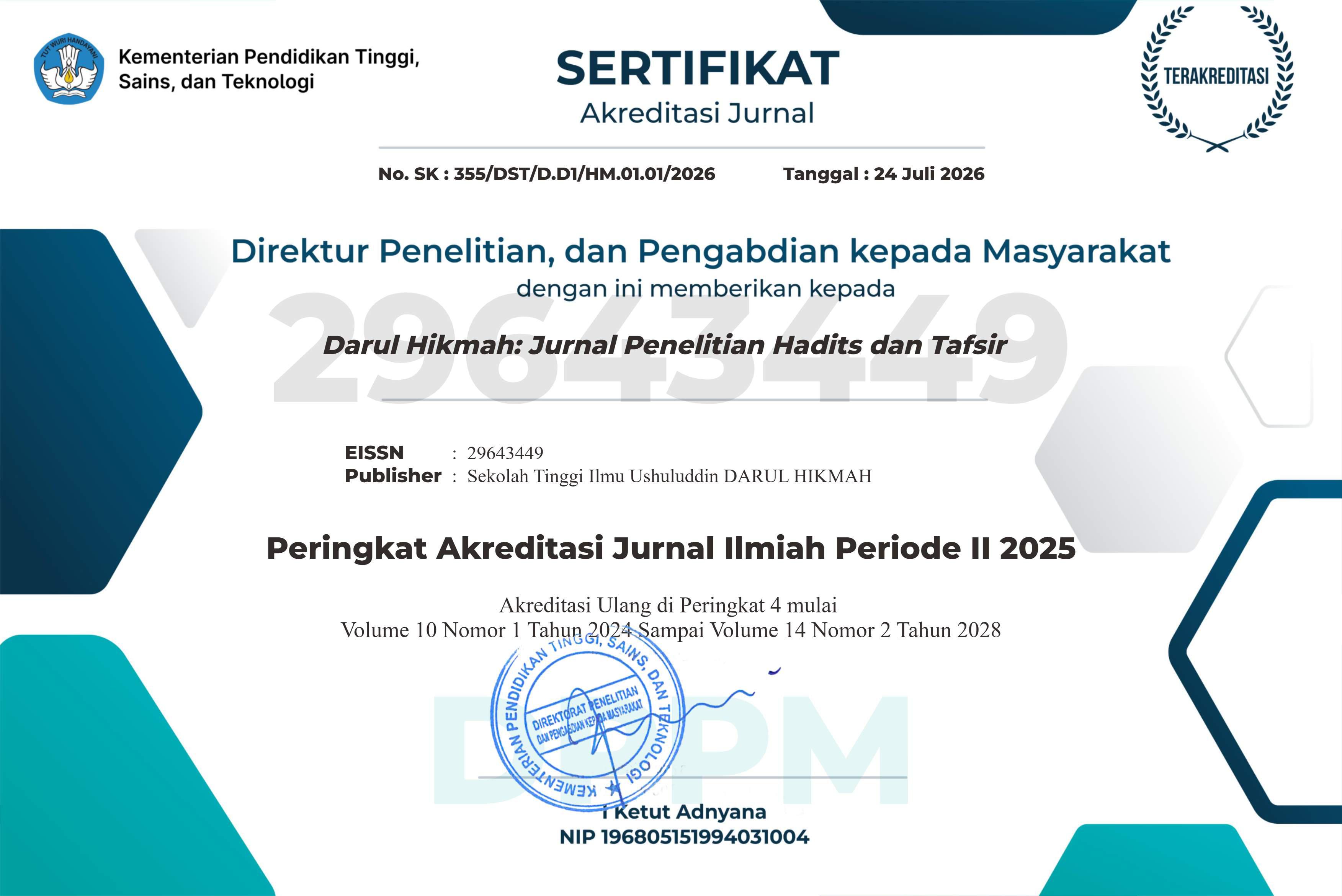

Darul Hikmah: Jurnal Penelitian Hadits dan Tafsir is a peer-reviewed journal published twice a year by STIU Darul Hikmah Bekasi. This journal is available online as an open-access resource as well as in printed form. This statement outlines the publication ethics that must be observed by all parties involved in the publication process of articles in this journal, including authors, editor-in-chief, editorial board members, reviewers, and publishers. This statement is based on the COPE (Committee on Publication Ethics) Best Practice Guidelines for Journal Editors.
The publication of an article in Darul Hikmah: Jurnal Penelitian Hadits dan Tafsir is an essential foundation in the development of a coherent knowledge network in accordance with international standards. It is a direct reflection of the quality of the authors’ work and the institutions supporting them. Articles supported by peer review contribute to the realization of a comprehensive scientific method. Therefore, it is important to agree upon standards of ethical conduct expected from all parties involved in the publication process: authors, editors, reviewers, publishers, and the academic community.
As the publisher, Darul Hikmah: Jurnal Penelitian Hadits dan Tafsir undertakes its custodial responsibilities over all stages of publication professionally and recognizes other ethical responsibilities. The Research and Community Service Institute (LPM) is committed to ensuring that advertisements, reprints, or other commercial revenues have no impact or influence on editorial decisions.
The editors of Darul Hikmah: Jurnal Penelitian Hadits dan Tafsir are responsible for deciding which submitted articles will be published. The validation of researchers’ work and its significance must always drive such decisions. Editors may be guided by the journal’s editorial board policies and constrained by legal requirements regarding defamation, copyright infringement, and plagiarism. Editors may consult with other editors or reviewers in making these decisions.
The editorial team evaluates manuscripts based solely on their intellectual content without regard to race, gender, sexual orientation, religious belief, ethnic origin, nationality, or political philosophy of the authors.
Editors and editorial staff must not disclose any information about submitted manuscripts to anyone other than the corresponding author, reviewers, prospective reviewers, other editorial advisers, and the publisher, as appropriate.
Unpublished materials disclosed in submitted manuscripts must not be used in an editor’s own research without the author’s explicit written consent.
Peer review assists editors in making editorial decisions and, through editorial communication with authors, may also help authors improve the quality of their manuscripts.
Any selected reviewer who feels unqualified to review the assigned manuscript or knows that a prompt review will be impossible should notify the editor and withdraw from the review process.
Any manuscript received for review must be treated as a confidential document. It must not be shown to or discussed with others except as authorized by the editor.
Reviews should be conducted objectively. Personal criticism of the author is inappropriate and must be avoided. Reviewers should express their views clearly with supporting arguments.
Reviewers should identify relevant published works that have not been cited by the authors. Any statement that an observation, derivation, or argument has been previously reported should be accompanied by the relevant citation.
Privileged information or ideas obtained through peer review must be kept confidential and not used for personal advantage. Reviewers should not review manuscripts in which they have conflicts of interest resulting from competitive, collaborative, or other relationships with any of the authors, companies, or institutions connected to the paper.
Authors of original research reports should present an accurate account of the work performed along with an objective discussion of its significance. Underlying data should be represented accurately. A paper should contain sufficient detail and references to permit others to replicate the work. Fraudulent or knowingly inaccurate statements constitute unethical behavior and are unacceptable.
Authors must ensure that they have written entirely original works. If the authors have used the work and/or words of others, this must be appropriately cited or quoted. The plagiarism threshold based on the Turnitin application is 30%.
An author should not publish the same manuscript in more than one journal or publication medium simultaneously during the review and publication process. Submitting the same manuscript to more than one journal concurrently constitutes unethical publishing behavior and is unacceptable.
Proper acknowledgment of the work of others must always be given. Authors should cite publications that have significantly influenced the nature of the reported work.
Authorship should be limited to those who have made significant contributions to the conception, design, execution, or interpretation of the reported study. All individuals who have made significant contributions should be listed as co-authors. Those who participated in certain substantive aspects of the research project should be acknowledged or listed as contributors. The corresponding author must ensure that all appropriate co-authors are included in the paper.
All authors should disclose any financial or other substantive conflicts of interest that may influence the results or interpretation of their manuscript. All sources of financial support for the project should also be disclosed.
When an author discovers a significant error or inaccuracy in their published work, it is the author’s obligation to promptly notify the journal editor or publisher and cooperate with the editor to retract or correct the paper.
Journal editors are fully and independently responsible for deciding which articles submitted to the journal should be published, often in cooperation with the relevant scholarly society (for society-owned or sponsored journals). Editors may be guided by the journal’s editorial board policies and constrained by legal requirements regarding defamation, copyright infringement, and plagiarism. Editors may consult with other editors or reviewers in making such decisions.
Editors must ensure that the peer-review process is fair, unbiased, and timely. Research articles should generally be reviewed by at least two external and independent reviewers, and editors should seek additional opinions where necessary. Editors should select reviewers with appropriate expertise in the relevant field and follow best practices to avoid selecting fraudulent peer reviewers. Editors should review all disclosures of potential conflicts of interest and suggestions for self-citation made by reviewers to determine whether there is any potential bias.
Editors should evaluate manuscripts based on their intellectual content without regard to race, gender, sexual orientation, religious belief, ethnic origin, nationality, or political philosophy of the authors. The journal’s editorial policies should encourage transparency and complete, honest reporting, and editors should ensure that peer reviewers and authors have a clear understanding of what is expected of them. Editors should use the journal’s standard electronic submission system for all journal communications. Editors should establish, together with the publisher, transparent mechanisms for appeals against editorial decisions.
Editors should not attempt to influence the journal’s ranking by artificially increasing journal metrics. In particular, editors should not require references to articles in the journal (or any other journal) except for genuine scholarly reasons.
Editors must protect the confidentiality of all submitted materials and all communications with reviewers unless otherwise agreed with the relevant authors and reviewers. In exceptional circumstances and in consultation with the publisher, editors may share limited information with editors of other journals if deemed necessary to investigate suspected research misconduct. Unless the journal operates an open peer-review system and/or reviewers have agreed to disclose their identities, editors must protect reviewers’ identities. Unpublished materials disclosed in submitted manuscripts must not be used in an editor’s own research without the author’s written consent. Privileged information or ideas obtained through peer review must be kept confidential and not used for personal gain.
Any potential editorial conflicts of interest must be declared to the publisher in writing before the editor’s appointment and updated whenever new conflicts arise. The publisher may publish such declarations in the journal. Editors must not be involved in decisions regarding papers they have written themselves or papers written by family members, colleagues, or related to products or services in which the editor has an interest. Such submissions must be subject to all the journal’s usual procedures, and peer review must be handled independently of the relevant author/editor and their research group. Editors should apply the publisher’s policies regarding disclosure of potential conflicts of interest by authors and reviewers.
Editors should work to safeguard the integrity of the published record by reviewing and assessing reported or suspected misconduct (research, publication, review, and editorial misconduct) in cooperation with the publisher (or scholarly society). Such measures generally include contacting the author of the manuscript or paper and giving due consideration to the respective complaint or claim, but may also involve further communication with relevant institutions and research bodies. Editors should make appropriate use of the publisher’s systems for detecting misconduct, such as plagiarism detection software.
Editors who find convincing evidence of misconduct should coordinate with the publisher (and/or scholarly society) to arrange appropriate corrective actions, such as corrections, retractions, expressions of concern, or other amendments to the published record, as necessary.
ACCREDITATION BY:
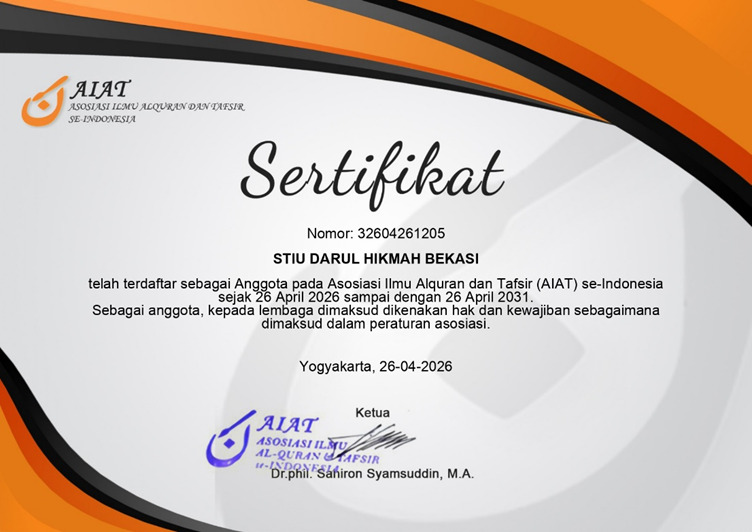
This Journal has been indexed with :



Tools Recommendation








Editorial Office:
Jurnal STIU Darul Hikmah Bekasi
Sekolah Tinggi Ilmu Ushuluddin (STIU) Darul Hikmah
Jl. Wibawa Mukti II Gg. H. Arnin Jatisari Jatiasih Bekasi Indonesia 17426
Telp. 0851-0076-9887
www.stiudarulhikmah.ac.id

This work is licensed under a Creative Commons Attribution-ShareAlike 4.0 International License .