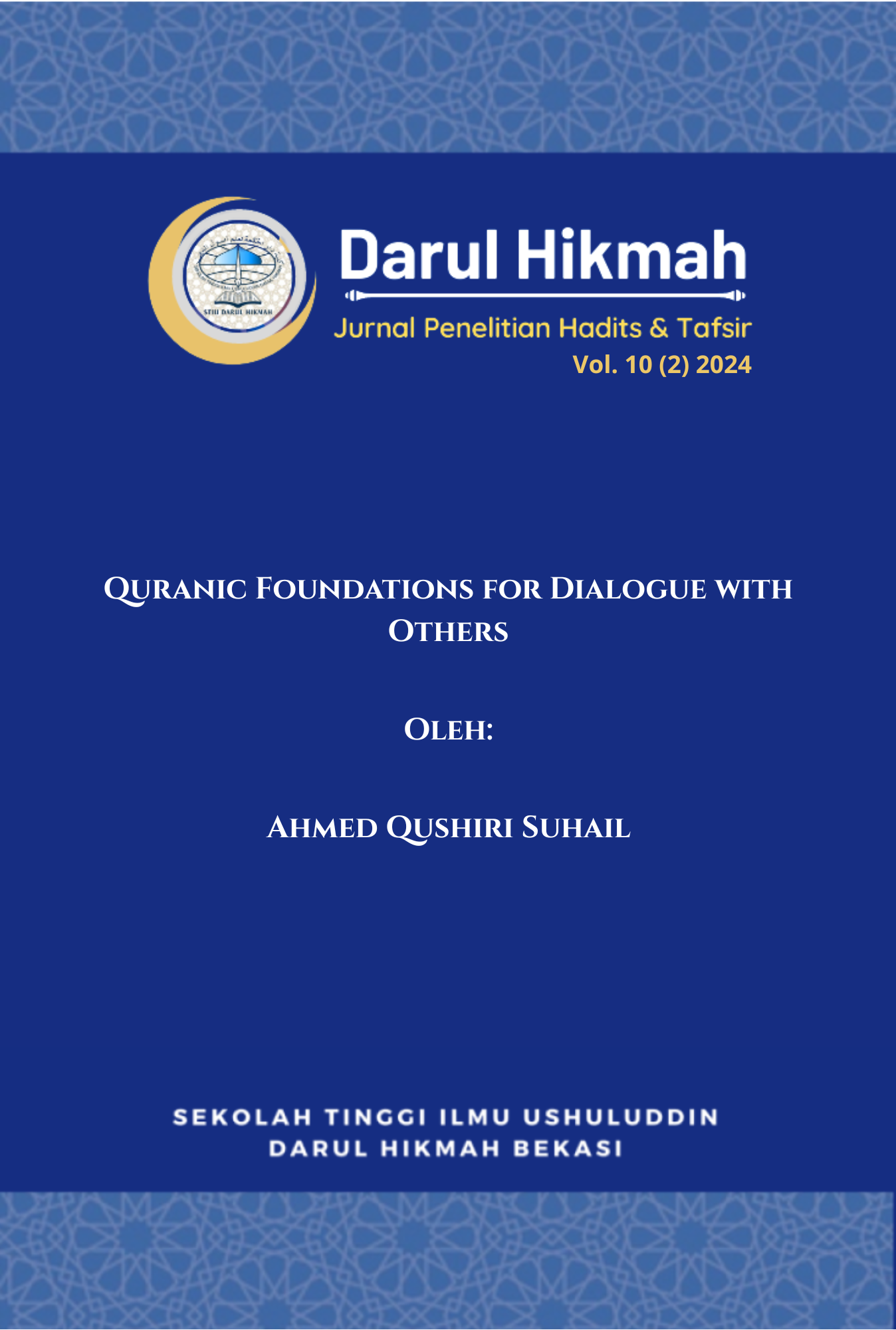
Quranic Foundations for Dialogue with Others
DOI:
https://doi.org/10.61086/jstiudh.v10i2.67Keywords:
Dialogue, Qur’an, Diversity, Tolerance, Da'wah, HumanityAbstract
This study explores the vital role of dialogue in human life, presenting it as a human necessity, a religious obligation, and a contemporary demand. From the Qur’anic perspective, dialogue is not merely a form of communication, but also a method of imparting knowledge, a means of da'wah (Islamic propagation), and a key strategy for peaceful coexistence. The objective of this research is to analyze the Qur’anic foundations of dialogue and identify the guiding principles for engaging with others. A qualitative methodology is adopted, utilizing library research and content analysis of Qur’anic verses that involve dialogue. The findings reveal that the Qur’an promotes dialogue as a core method for social engagement and da'wah, even in matters of creed and belief. It emphasizes recognition of the other, affirms difference as a divine law, and advocates for reasoned, ethical, and informed discourse. The implications suggest that Muslims should prioritize dialogue to counter modern challenges such as Islamophobia and religious conflicts, and to foster a culture of tolerance and mutual respect.
Downloads
Published
Issue
Section
License
This work is licensed under a Creative Commons Attribution-NonCommercial-ShareAlike 4.0 International License.
You are free to:
- Share — copy and redistribute the material in any medium or format
- Adapt — remix, transform, and build upon the material
- The licensor cannot revoke these freedoms as long as you follow the license terms.
Under the following terms:
- Attribution — You must give appropriate credit, provide a link to the license, and indicate if changes were made. You may do so in any reasonable manner, but not in any way that suggests the licensor endorses you or your use.
- NonCommercial — You may not use the material for commercial purposes.
- ShareAlike — If you remix, transform, or build upon the material, you must distribute your contributions under the same license as the original.
- No additional restrictions — You may not apply legal terms or technological measures that legally restrict others from doing anything the license permits.
Notices:
You do not have to comply with the license for elements of the material in the public domain or where your use is permitted by an applicable exception or limitation.
No warranties are given. The license may not give you all of the permissions necessary for your intended use. For example, other rights such as publicity, privacy, or moral rights may limit how you use the material.